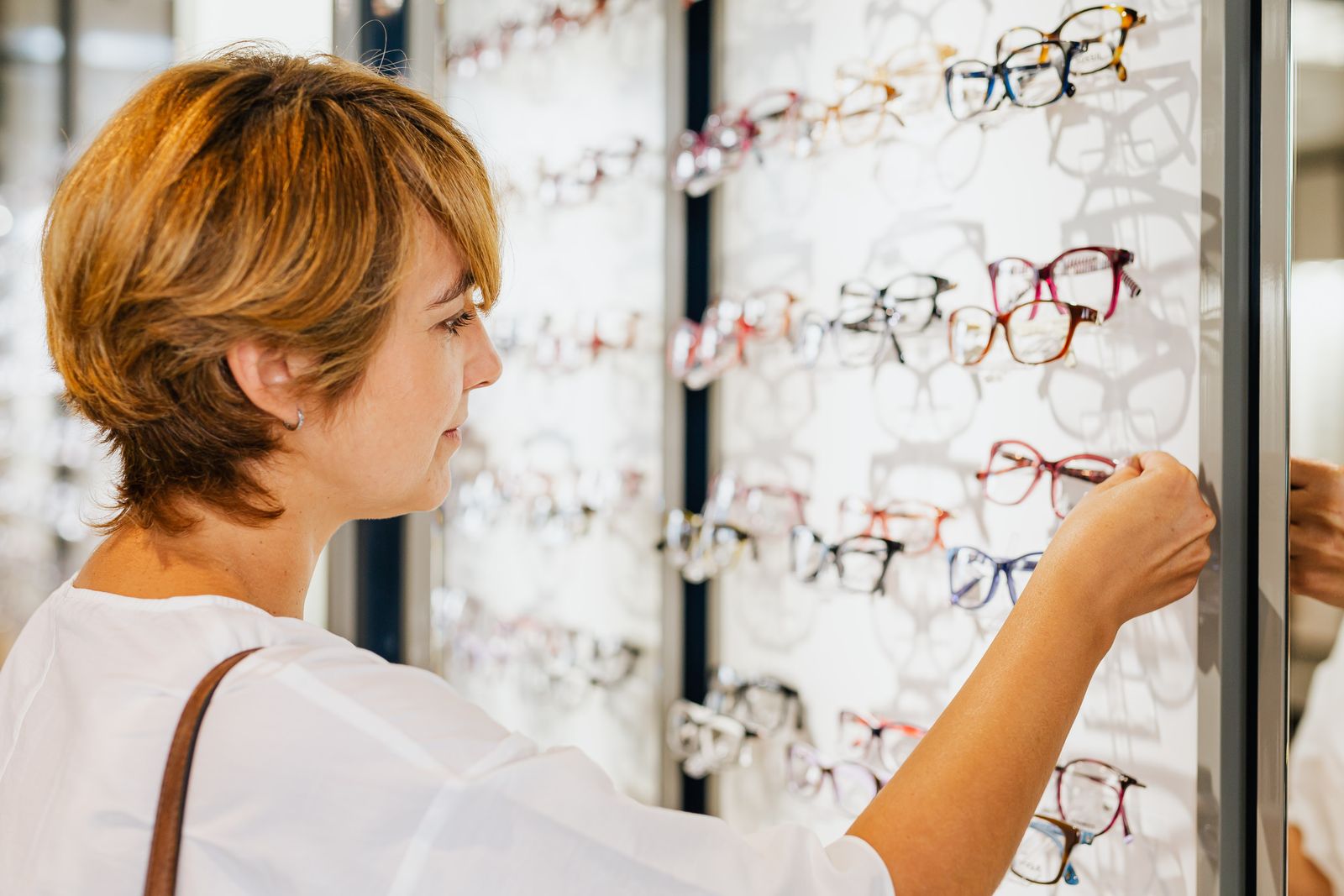
Virtual try-on for glasses lets a customer try on a frame directly from their screen, using their smartphone or computer camera, before buying online. For opticians and eyewear brands, this technology answers a very concrete problem: how do you sell a product as personal as a pair of glasses when the customer can’t wear it before paying? Here’s how the technology works, what it actually changes for conversion and returns, and how to choose the right solution to integrate into your online store.
Why virtual try-on for glasses is becoming an e-commerce standard
The global eyewear market is expected to reach $156.35 billion in 2026, according to Statista. A growing share of that market happens online, on a product that nonetheless remains hard to sell without trying it on: face shape, frame size, and color rendering are decisive factors that standard product pages can’t convey.
This difficulty shows up directly in return figures. According to the National Retail Federation, 19.3% of online purchases were returned in 2025, compared with 15.8% across all channels combined: uncertainty about a product’s appearance before purchase remains one of the leading drivers of e-commerce returns. For eyewear, an industry where trying frames on in person has long been the absolute norm, this gap represents both a barrier to online sales and a clear opportunity for brands able to address it through technology rather than through free-return policies alone.

How augmented reality virtual try-on technology works
In practice, virtual try-on for glasses relies on real-time face mapping: the camera detects facial landmarks (eyes, brow line, ears, nose) and positions a 3D model of the frame with dynamic adjustment to every head movement. The perceived quality of the experience depends almost entirely on the precision of this facial tracking and the realism of the frames’ 3D models, which need to faithfully reproduce materials, reflections, and the product’s true scale.
Real-time augmented reality vs. photo-based try-on
Two technical approaches coexist today. The first, real-time augmented reality via webcam, offers the smoothest experience and the closest to trying frames on in person: the customer moves their head, changes angle, and compares several frames within seconds. The second, based on AI analysis of a static photo, is technically lighter and works on older devices, but reproduces movement and lighting effects less faithfully. The choice between the two mainly depends on your audience’s device mix and your brand’s visual standards: a premium brand generally benefits from investing in real time, while a mass-market player can start with a photo-based solution to validate usage before going further.
This question of technical investment level ties into the broader one of choosing between a SaaS solution and custom development for any 3D configurator or virtual try-on project: the right level of technical ambition is always defined by the catalog and business goals, not the other way around.
Measurable benefits for brands and opticians
Available data on the impact of augmented reality and 3D in e-commerce, while rarely specific to eyewear, provides solid orders of magnitude. A case study reported by Shopify on the Rebecca Minkoff brand shows that visitors who saw a product in augmented reality were 65% more likely to buy it, and those who saw a 3D model were 44% more likely to add it to their cart. In another case, furniture brand Oakywood saw its average order value grow by 458% in Germany, 232% in Switzerland, and 84% in the UK after introducing 3D and AR content: the underlying logic — understanding a product before buying it builds trust and increases spend — applies directly to a product as visual as a pair of glasses.
The second lever, just as important for an online store’s profitability, concerns returns. According to a study commissioned by Snap Inc. and Publicis Media among more than 4,000 consumers, 66% of shoppers say they’re less likely to return a product after viewing it in augmented reality, and 80% say they feel more confident in their purchase decision. For eyewear, where a return often means reconditioning a frame with prescription lenses already fitted, every avoided return weighs heavily on the real profitability of an online sale.
Criteria for choosing the right virtual try-on solution
Not all virtual try-on solutions are equal. Before selecting a provider or platform, a few technical and business criteria are worth checking:
- Facial tracking precision: an approximate fit of the frame on the face immediately breaks the credibility of the experience and can even discourage the purchase.
- Fidelity of the catalog’s 3D models: materials, colors, and scale must exactly match the real product, or risk disappointing the customer on delivery.
- Mobile and desktop compatibility: since most e-commerce traffic is mobile, the experience needs to stay smooth with no app download required.
- Integration with your platform: Shopify, WooCommerce, or a custom CMS, with product catalog and stock synchronization.
- Biometric data handling: facial tracking involves processing sensitive data under GDPR; processing should stay local to the browser or be covered by explicit consent and a clear retention policy.
- Load time: poorly optimized 3D models slow down the product page and hurt both user experience and SEO.
Common mistakes to avoid during integration
The first mistake is rolling out virtual try-on across the entire catalog from day one, without first validating usage on a selection of flagship frames: 3D modeling costs rise quickly and return on investment becomes harder to measure. The second is neglecting testing across a genuinely diverse range of face shapes, skin tones, and lighting conditions: facial tracking validated on a single typical profile produces a disappointing, even exclusionary, experience for part of your visitors. The third mistake, more strategic, is presenting virtual try-on as an isolated marketing gimmick rather than a sales tool integrated into the purchase journey: without a clear call to action, without a direct link to the product page and cart, the try-on stays a toy that customers abandon without converting.
How to integrate virtual try-on into your online store: a 4-step method
- 1. Audit the catalog: identify priority frames (best sellers, most-returned ranges) and check the availability of 3D files or usable photos for modeling.
- 2. Choose the technical approach: real-time augmented reality or photo-based try-on, SaaS solution or custom development, based on your visual standards and available budget.
- 3. Design the user experience: virtual try-on needs to integrate naturally into the product page, with immediate, frictionless access from the browsing page.
- 4. Measure and iterate: track virtual try-on usage rate, its impact on conversion rate and return rate, then gradually extend the feature across the full catalog.
This methodology ties into the general principles of UX/UI design for virtual try-on: technology alone is never enough to convert — it’s the quality of its integration into the purchase journey that makes the difference.
FAQ
Does virtual try-on for glasses replace an eye exam at the optician’s?
No. Virtual try-on only covers the appearance and aesthetic fit of the frame; it doesn’t replace an eye exam or the medical advice of a vision care professional.
Do you need a dedicated app to offer virtual try-on?
No, most modern solutions work directly in the browser, using the smartphone or computer camera, with no app download required: that’s now the expected standard for avoiding extra friction in the purchase journey.
Does virtual try-on work for all face shapes?
It depends directly on the quality of the facial tracking model used: a well-designed solution must be tested and validated across a wide range of face shapes before going into production, or part of your visitors will get a degraded experience.
Inspir3d’s expertise
At Inspir3d, we design custom virtual try-on and 3D configuration experiences for e-commerce brands and retailers who demand a high-quality customer experience, from catalog audit through to full technical integration. If you’re considering adding virtual try-on to your online store, let’s talk about your project to define the approach best suited to your catalog together.
