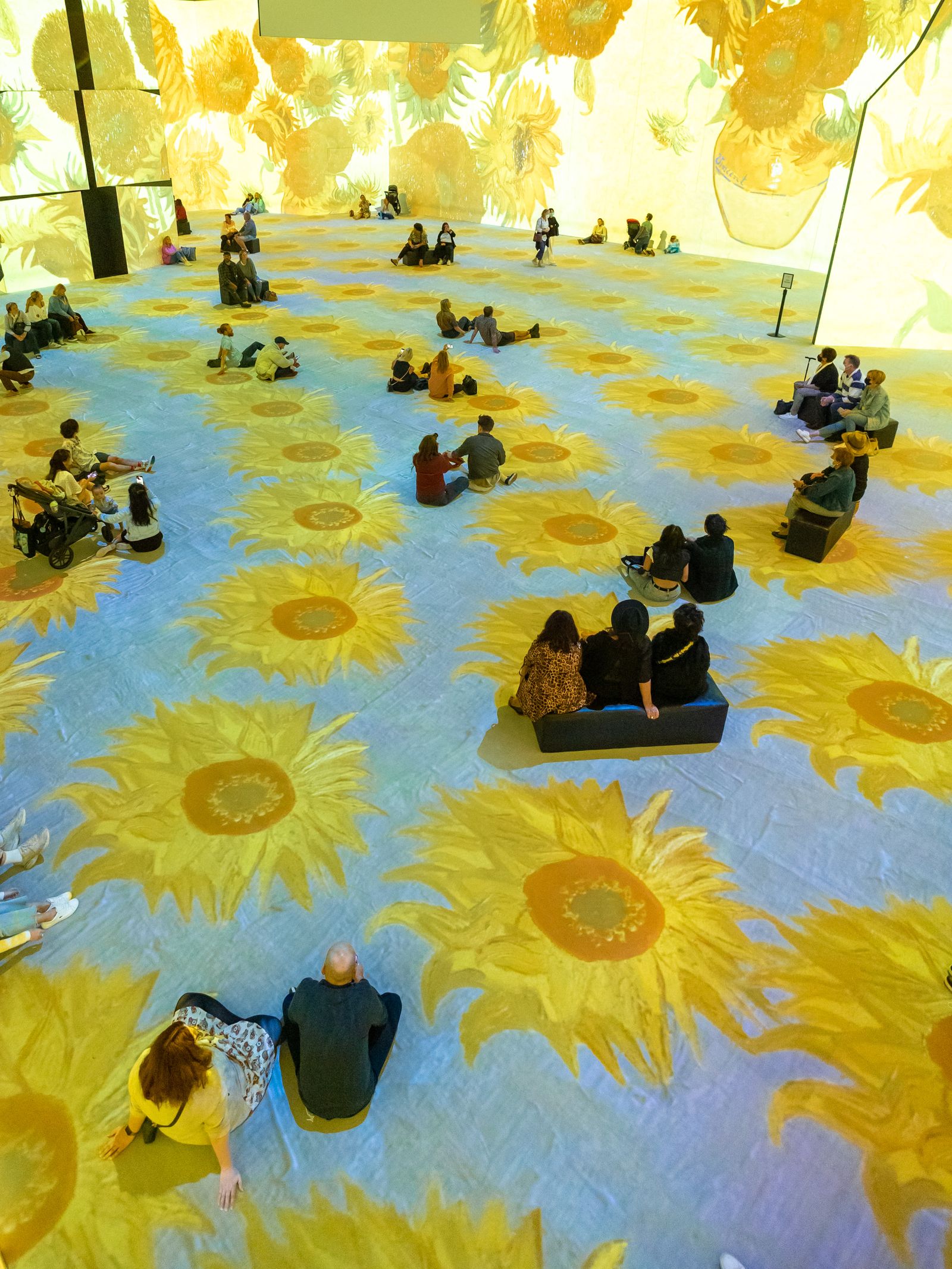
Immersive venues no longer just project images onto walls. They sell a visitor journey: a sequence of moments designed to move, guide, surprise and leave a mark. Yet many projects invest in technology and forget to design the journey itself. The result: poorly managed queues, lost visitors, and a “wow” effect that fades after ten minutes.
A fast-growing sector, hence an increasingly competitive one
In the United States, more than 350 permanent immersive venues account for roughly 30 to 35 million visits in 2025, with a forecast of 40 million or more in 2026 and at least 20 major new venues announced, according to an analysis by White Hutchinson. The largest sites welcome between 500,000 and 1 million visitors a year, mid-sized immersive museums between 50,000 and 200,000.
Globally, Mordor Intelligence sizes the immersive entertainment market at USD 146.9 billion in 2026 and USD 260.8 billion by 2031 (12.16% annual growth). The more supply grows, the more the quality of the journey becomes the differentiator.
The five key moments of an immersive journey
1. Before the visit: frictionless booking
The journey starts on the website: clear time slots, visible capacity, understandable pricing, accessibility and duration information. A visitor unsure how their visit will work will not book.
2. Arrival: a threshold, not a ticket desk
First contact sets the tone. An entry airlock, a sound ambience and a few short, legible instructions prepare visitors to cross into another world without stress.
3. The core experience: rhythm and freedom of choice
A successful immersion alternates intense moments with breathing space. In the Musée d’Orsay VR experience produced with GEDEON Experiences, viewers can even choose not to follow the narration, as its producers explain in this CNC interview. Giving visitors agency makes them participants rather than spectators.
4. Exit: turning emotion into a next step
This is the ideal moment to offer a digital keepsake, sharing, a shop, a review or feedback. An experience that stops abruptly leaves its emotion untapped.
5. After the visit: extending the relationship
A thank-you email, a personalised gallery, an offer to return: this is what fuels word of mouth and loyalty.
Design for operations from day one
A good journey is also one that teams can actually run. The VR experience “Gaudí, the Atelier of the Divine”, for example, was designed to be multilingual, light to install and simple to operate, as highlighted in this Unifrance article. Such choices cut operating costs and ease international touring.
Plan from the start for: flow and queue management, equipment cleaning and sanitising, staff training, multilingual support, technical incident handling and a fallback mode when a scene fails.
The role of digital in the journey
A configurator or companion app can personalise the visit: choosing a route by age or available time, customising an avatar, a memory gallery. Augmented reality can extend the experience at home or on site without heavy equipment. The key is discretion: technology must serve the story, never overwhelm it.
Frequently asked questions
What is the ideal duration for an immersive experience?
It depends on the format, but a short, dense experience beats a long repetitive sequence. Test with real visitors before locking the journey.
How do you measure a journey’s success?
Track booking rate, average wait time, recommendation rate, average shop basket and the number of visitors who return or share their visit.
Can a mid-sized venue compete with the big names?
Yes, by betting on a strong identity, an original story and a flawless journey rather than technological one-upmanship.
Going further
Inspir3d Studio designs immersive experiences and interfaces that accompany visitors, from the booking site to the experience itself. You may also read our article on UX/UI design for 3D configurators. To discuss a venue or immersive journey project, get in touch with our team.
